The Problem with Free-Attack Systems
In most card games, your creatures can attack anything. Any enemy creature, the opponent directly — the board is a free-for-all. This creates exciting moments, but it also means that positioning barely matters. A creature in "slot 1" plays identically to a creature in "slot 5."
Lane combat changes that. When creatures hold specific positions and the lane across from them decides whether they can reach the enemy Sheriff, every placement becomes a decision. Where you put a creature matters as much as which creature you play.
How Lanes Work in Goblins & Gunslingers
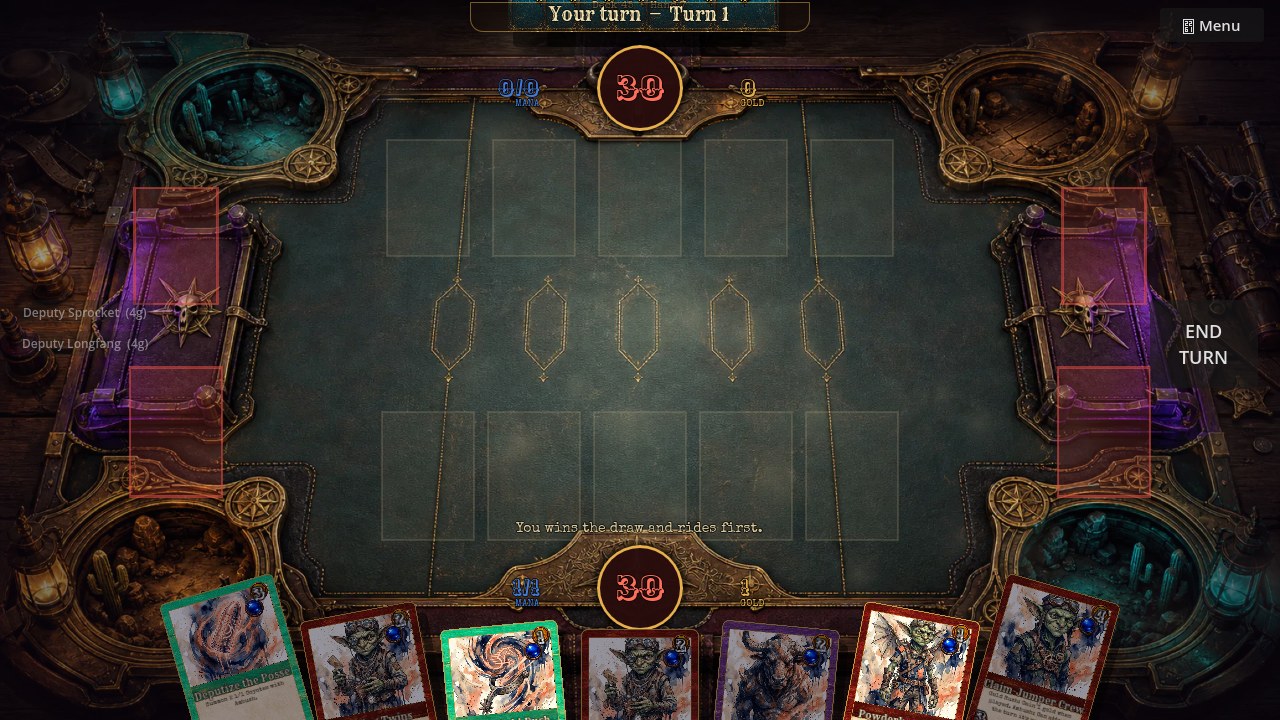
GNG uses a 7-lane battlefield arranged in two tiers (the how to play page has the full ruleset):
- 2 High-Rise Lanes — Only 1 creature per lane. Units in High-Rise stay concealed and untargetable until they attack. They can only fight other High-Rise creatures or Middle Lane creatures — they cannot attack the opponent directly. Think of them as snipers on the rooftops.
- 5 Middle Lanes — The main battleground. Creatures here can pick a fight with any enemy creature in the Middle Lanes, but they must clear whatever sits directly across from them — creature or Cover Token — before they can hit the opposing Sheriff. This is where most of the fighting happens.
Why Blocking Changes Everything
The blocking rule is what makes lane combat strategic. In a free-attack game, you can always ignore a threat and go face. In GNG, if your opponent places a creature with Warrant — like Bounty Hunter Jed (4M/2G, 4/3) — in front of your best attacker, you have to deal with it first. You cannot just fly past.
This creates a puzzle every turn: where do I place my next creature? Do I reinforce a lane I'm winning, or open a new front? Do I drop a Cover Token (0/1 blocker) in an empty lane to stall while I build up elsewhere? A Cover Token intercepts every attack down its lane until somebody clears it.
High-Rise: The Tactical Layer
High-Rise lanes add vertical strategy. A creature like Telegraph Runner (2M, Flying) in High-Rise stays concealed and can't be targeted until it attacks. But it also can't attack the opponent directly — only other creatures. This makes High-Rise a zone for precision threats, not face damage.
The interaction between High-Rise and Middle Lanes creates flanking opportunities. A Straw Elf player might stack untargetable Wanted creatures on High-Rise while grinding Middle Lanes with Cover Tokens. A Goblin player might ignore High-Rise entirely and overwhelm the five Middle Lanes with Ambush creatures before the opponent can set up.
Keywords That Exploit Lanes
Several GNG keywords are designed around lane interaction (the keyword glossary defines every one of them):
- Overshot — Excess damage spills to the next target or player. Highwayman (4M/2G, 5/3) kills a 2-defense blocker and pushes 3 damage through.
- Cover Tokens — Place 0/1 blockers in empty lanes. Blacksmith Hank (3M, 2/3) creates one on play. Cheap walls that buy time.
- Flying — Bypasses Cover Tokens. Mirage Stalker (1M, 1/1) flies right over ground defenses.
- Warrant — Forces enemies to attack this creature first. Locks a lane down and makes the opponent fight on your terms.
- Tunnel — Dwarves can summon Tunnel creatures in any lane regardless of blocking. Shaft Runner (1M, 1/2) appears wherever you need a wall.
Lane Combat Makes Every Game Different
Because placement matters, no two GNG games play out the same way — even with identical decks. The spatial dimension means you are always making decisions that free-attack games simply don't offer. It's chess with cards, not just math with cards. For the finer points of clearing cover and sniping from the rooftops, read our open combat guide.
Want to experience it? GNG is free in your browser and free on Steam in Early Access. The tutorial teaches lane combat in under five minutes — play free at the Online Outpost.