Why Two Resources?
Most trading card games use a single resource: mana, energy, lands, whatever you call it. You get more each turn, you spend it on cards. Simple. But single-resource systems have a known problem — they reduce decisions. If you have 5 mana and a 5-cost card, you play it. There's rarely a meaningful choice about how to spend.
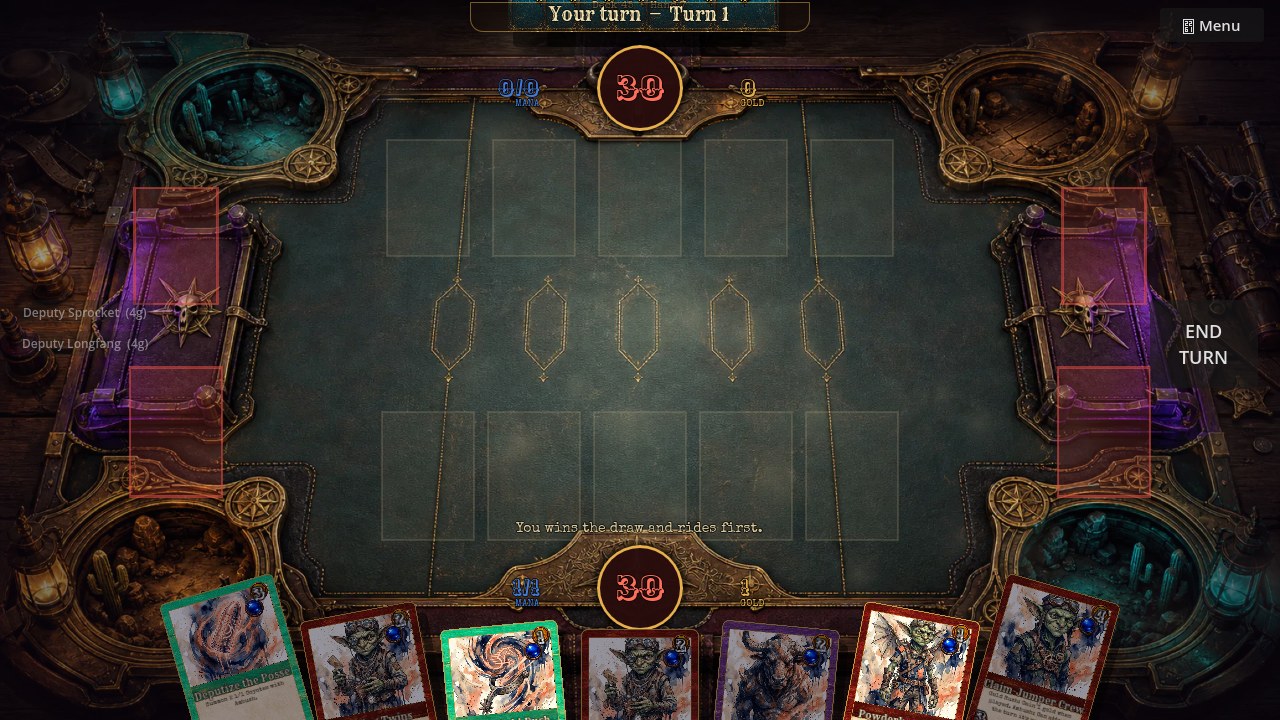
Goblins & Gunslingers splits the economy into two currencies that behave completely differently. The tension between them is where the strategy lives.
Mana: The Ramp
Mana works like most card games expect. On turn 1 you get 1 mana, turn 2 you get 2, turn 3 you get 3, and so on with no cap. It fully replenishes at the start of each turn.
Mana is predictable. You always know exactly how much you'll have next turn. This lets you plan your curve — the sequence of increasingly expensive cards you play each turn. A 1-drop on turn 1, a 2-drop on turn 2, and so on.
Gold: The Refresh
Gold does not ramp or accumulate. At the start of each turn, it refreshes to 1 base Gold plus 1 bonus Gold for every damage instance you dealt to the opponent last turn. Unspent Gold is replaced at that refresh, so it does not bank from turn to turn.
Damage instances matter, not damage points. One hit to the opposing Sheriff is one instance and earns +1 bonus Gold for your next refresh, whether that hit deals 1 damage or 5. A creature with Double Barrel can land two separate hits, so both successful hits can earn two bonus Gold for the next turn.
Gold rewards pressure, but only when damage reaches the opponent; a hit that stops on a Cover Token earns nothing. A turn without opponent damage means your next refresh returns to the 1 base Gold.
Cards Cost Both
Many Season 2 cards cost Mana only, including Greasepalm Goblin (1M, 1/1, Gold Rush). Some sturdier plays ask for both resources. Coinvault Sentinel (4M/1G, 3/5, Barricade and Ironclad) needs the predictable Mana curve plus Gold you preserved for the current action phase. Motherlode Baron Durgan (6M/2G, 5/7) asks for an even larger Gold commitment in exchange for a durable Barricade body and a Last Stand Gold payoff.
This creates a genuine decision point every turn. Do you spend the Gold available now on a card, ability, or Deputy, or sequence another play first? Leftover Gold disappears at the next refresh, while damage you deal this turn determines that next pool.
Gold Rush and Gold Economy Cards
Some cards generate Gold directly. Greasepalm Goblin (1M, 1/1) and Bounty Tracker (2M, 3/1) each add 1 Gold to the current turn when played. Claim-Jumper Crew (4M, 3/3) combines Gold Rush with Ambush, giving you both spending flexibility and immediate pressure.
Gold Rush rewards sequencing. Play the generator before the card or ability that needs Gold, and spend that pool before the next Resource Phase replaces it.
Deputies: The Gold Sink
Deputies are special cards kept outside your deck that cost Gold to summon and activate. They're a powerful use for the Gold available in the current action phase, especially for decks that create several damage instances or use Gold Rush effects.
The Strategic Axis
The dual resource system creates a genuine strategic axis that single-resource games don't have. Mana rewards curve planning. Gold rewards separate damage instances, clean sequencing, and spending the pool you have before it refreshes. The balance changes with your faction, your opponent, and the board state.
The quickest way to feel the difference is to sit down at a free table in the Online Outpost and try spending both.