What Is Frontier Run?
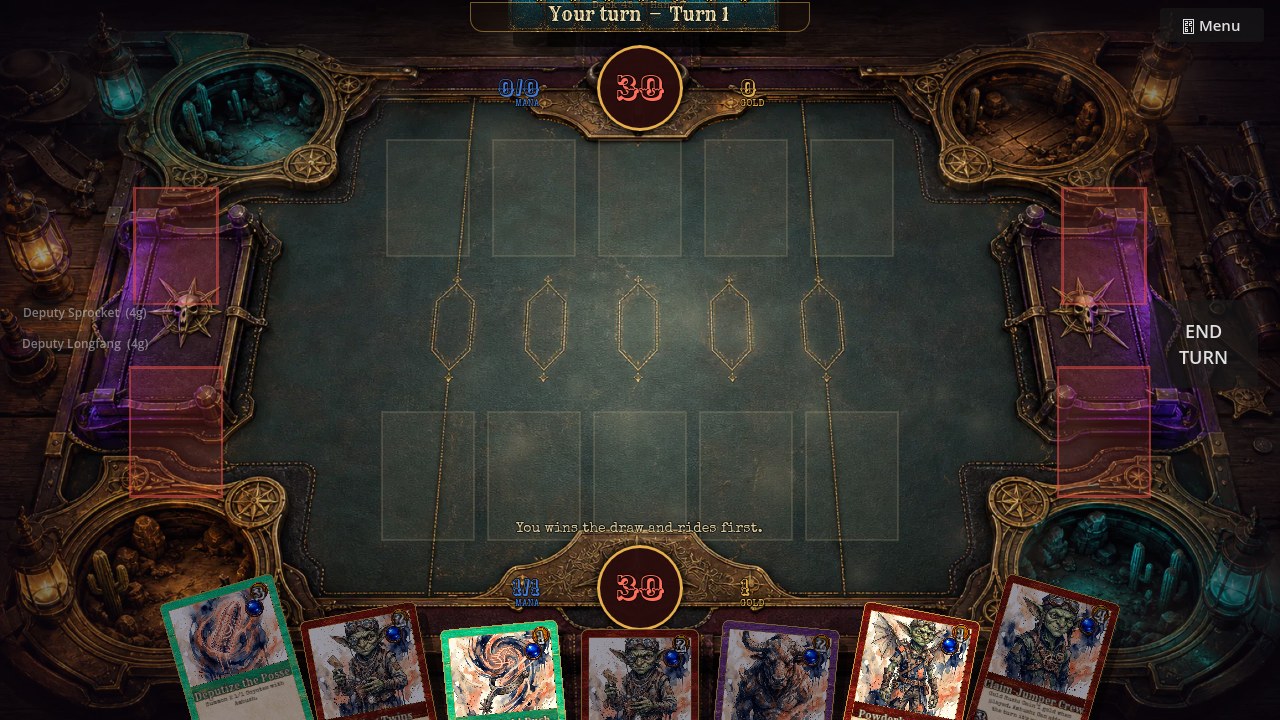
Frontier Run is the single-player campaign mode in Goblins & Gunslingers. Instead of a single duel, you embark on a branching roguelike climb through the Wild Frontier. Your HP carries between fights, your deck evolves mid-run, and your route choices determine what you face next.
Think of it as a roguelike deckbuilder built on top of the core GNG card game. Same lane combat, same Mana and Gold, same keywords — but wrapped in a longer adventure that rewards risk management and deck adaptation. It runs in the browser at the Online Outpost and in the Steam build, and it costs nothing.
How It Differs from a Normal Duel
In a normal duel, both players start at 30 HP with their full decks. One match, one winner. Frontier Run changes the format:
- 150 Trail HP — You start with 150 HP instead of 30. This pool carries across every fight in the run. Taking 10 damage in fight 1 means you enter fight 2 at 140 HP.
- Issued Crew — You ride out with an issued crew, a two-faction pairing the campaign hands you at the trailhead. Goblins & Desert Devils bring fast powder and infernal pressure; Humans & Straw Elves hold the road and build Cover. Clearing Stage I issues a third crew, Gnomes & Desert Devils.
- Branching Routes — A run is a trail of roughly a dozen floors, and after each stop you choose between the paths ahead. Each path leads to a different node — a battle, an elite fight, an outpost, a shop, an event, or the stage boss.
- Run-Only Rewards — Cards you recruit on the trail join your run deck for the climb, and they stay on the trail. Nothing you pick up in Frontier Run enters your account collection, so the campaign never leaks into the ranked card pool.
Ashfall Trail: Stage I
The first Frontier Run stage is Ashfall Trail. It is the introduction to the campaign format and the foundation the longer frontier is built on. Ashfall Trail features:
- Branching route choices between every stop, from the Ashfall Trailhead down into the Basin
- Shops where you spend the Gold you carry off the trail, and outposts like Dustwater that patch you up for the road ahead
- Escalating enemy difficulty as you approach the stage boss, with named set pieces such as the Ashfall Coach Heist along the way
- A proper stage-clear reward when you finish the trail
Cinder Crown Pass: Stage II
Clear Ashfall Trail and the trail keeps going. Cinder Crown Pass is the second stage, a harder climb with its own elites, a mid-boss partway up, and Malvora's war line waiting at the top. Cards you earn there go into a Frontier vault and ride with you on future Cinder Crown runs, so a failed attempt still leaves you better equipped for the next one.
Heat and the Last Chance
Two systems keep a run from settling into a routine. Heat is the frontier noticing you. Every battle raises it, elites and bosses raise it faster, and each level of Heat gives enemies more HP while paying out bigger rewards. Trail events let you trade it around: crack a lockbox for Ore and Gold at the cost of HP and Heat, or escort survivors for Dust, a recruit, and a cooler trail. It caps at five, so a hot run is a dangerous, lucrative run.
Last Chance is your one recovery. When the posse is scattered, Rosario can rally them a single time per run — you ride on with a fraction of your HP, lose some Gold, and Heat cools off. Use it and there is no second net. Until you have a feel for how much damage a floor costs, treat Last Chance as the reason you can afford one bad fight, not two.
Trail Gear
Recovery stops offer run-only gear that shapes the rest of the climb. The Iron Canteen adds 25 maximum trail HP and heals 25 on the spot. The Gilded Spur carries 2 extra Gold into every duel, which matters a great deal in a game where Gold refreshes every turn. The Prospector's Pan pays 50% more Ore for won duels, and the Outlaw Ledger pays 40% more Dust while giving enemies 8 extra HP. Like recruited cards, gear never leaves the trail.
Strategy Tips for Frontier Run
Preserve HP Early
Your 150 trail HP is a shared resource across the entire run. It is tempting to trade aggressively in early fights, but every point of damage you take is permanent until an outpost or a canteen gives it back. Play early fights more conservatively than you would in a single duel.
Adapt Your Deck
The cards you recruit mid-run can shift your strategy. If you start with a Goblin aggro crew but pick up strong defensive recruits, consider pivoting to a more midrange approach. Flexibility wins runs, and the deck-building fundamentals — curve, win condition, a clear plan — apply to a run deck just as much as a ranked one.
Route Selection Matters
Shops and gear strengthen your deck for later fights. Battles test your current build and drain HP. The best route depends on your current HP total, your Heat, and your deck state. If you are healthy, take battles for rewards. If you are low, find an outpost to recover or an event that cools the trail.
The Boss Is the Goal
Everything in a Frontier Run leads to the stage boss. Your entire run should be preparing for that final encounter. Do not burn resources or HP on flashy plays in early fights if it means arriving at the boss in a weakened state, and remember that a boss fight also spikes your Heat.
What's Next
Two stages are on the trail today, and the campaign keeps expanding with new routes, new recruits, and new bosses. The roadmap tracks what is riding in next.
Ready to ride? Sign in at the Online Outpost, pick a crew, and start a Frontier Run from the main menu. The Ashfall Trail awaits.