Your First Deck Will Be Bad. That Is Fine.
Everybody's first deck is a pile of the coolest cards they own. It loses. Then you learn why, and the next one loses less. This guide skips a few of those losses.
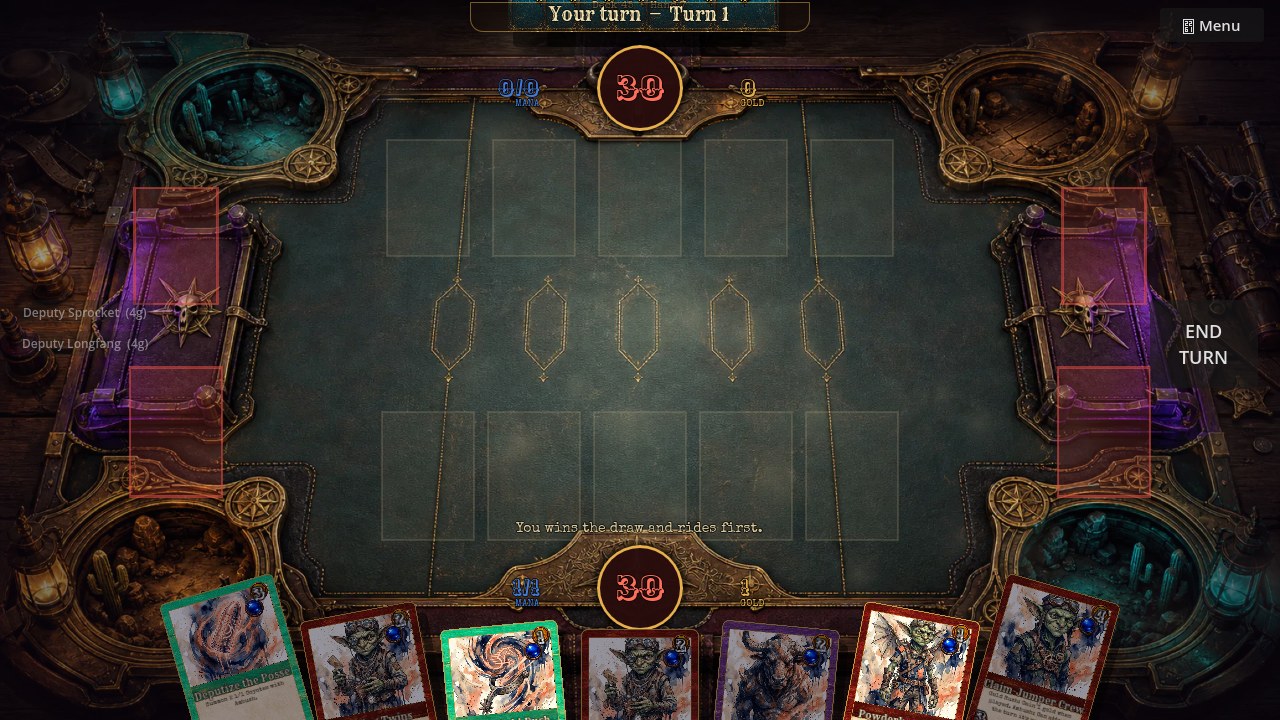
These principles apply to most collectible card games. The specifics below are for Goblins & Gunslingers, a free western-fantasy card game you can play in your browser or on Steam, but the thinking travels.
Rule One: Pick a Plan, Not a Pile
Before you add a single card, answer one question: how does this deck actually win? Are you flooding the board early and pushing damage before the opponent stabilises? Are you surviving to the late game where your expensive cards outclass theirs? Are you grinding value until they run dry?
A deck that does one of those well beats a deck that does all three badly. Every card you add should serve the plan. If you cannot explain why a card is in the deck, it is not in the deck.
Rule Two: Respect the Curve
Your curve is how your cards' costs are distributed. Resources grow as the game goes on, so a deck full of expensive cards does nothing for the first several turns — and you will simply be dead before you cast them.
A healthy starting shape leans on cheap and mid-cost cards, thins out through the expensive ones, and keeps only a couple of true top-end finishers. If you are ever unsure whether to cut a five-cost or a two-cost, cut the five.
Rule Three: Two Factions, Maximum
Goblins & Gunslingers decks hold 52 cards, up to 2 copies of any single card, and may draw on at most two main factions — Human, Goblin, Desert Devil, Straw Elf, Gnome, Dwarf, or Golem.
Two useful wrinkles. Beasts are wild: they slot into any deck without counting against your two factions. And Gnomes and Golems count as one faction together, because Gnomes flip into Golems mid-game — that pairing is a single choice, not two.
Splashing a third faction feels clever and plays badly. Consistency wins more games than variety.
Rule Four: Your Deputies Matter More Than You Think
Every deck runs two Deputies — summonable characters that sit outside your 52. They are the most reliable cards you own, because they are always available. You will see them every single game.
Pick Deputies that patch your plan's weakness rather than ones that pile on its strength. An aggressive deck that always runs out of steam wants a Deputy that refuels; a slow deck that dies to early pressure wants one that stabilises.
Rule Five: Count Your Answers
New players load up on threats and forget answers. If your deck has no way to remove an opposing creature, then the first big body your opponent lands simply wins the game.
Removal, damage spells, and tricks that break up a board are not wasted slots. They are what stop you losing to a single card.
Common Beginner Mistakes
One-of everything. Two copies of a card you want to see beats one copy each of two cards you might see. Consistency, again.
Too many expensive cards. Everyone overrates the top end. Cut one. Then cut another.
No early plays. If your first play is on turn four, you have handed over the first three turns for free.
Building for the mirror. Do not tune your whole deck against the one opponent who beat you yesterday.
Then Go Lose Some Games
Deckbuilding is iterative. Play ten games, note every hand you could not act on and every card you were sad to draw, and cut accordingly. That loop — build, lose, adjust — is the skill. When the basics stick, the guide to curve, factions, and win conditions is the next read.
Goblins & Gunslingers is free and runs in the browser, so the only thing an experiment costs you is a few minutes. Build the bad deck. Find out why. Build a better one.
The deck builder is waiting in the Online Outpost, and you do not need an account to start stacking cards.