"Free" Is Doing a Lot of Work in That Sentence
Every card game on the market calls itself free to play. Some mean it. Others mean the download is free and the competitive deck is ninety dollars away. The difference is not obvious from the store page, and you usually find out three weeks in, after you already care.
Here is what to actually look at.
Question One: Can You Build a Competitive Deck Without Paying?
Not a deck. A deck that can beat the decks the paying players are using. If the top-tier lists are all built around cards with a 1% drop rate, the answer is no, whatever the marketing says.
Watch for games where the strongest cards are the rarest cards. That is a design choice, and it is a choice about your wallet.
Question Two: Is Power Sold, or Is Presentation Sold?
The cleanest free-to-play model sells things that do not change what happens on the board — card backs, boards, portraits, cosmetics. You can spend nothing and lose nothing but bragging rights.
The moment a purchase makes a card better rather than prettier, the game is asking you to pay to win, however gently it phrases it.
Question Three: What Happens When a New Set Drops?
This is the one people forget. A game can be generous at launch and brutal at rotation. If every expansion resets your collection to near zero and the old cards stop being legal, you are not building a collection — you are renting one on a schedule.
Question Four: How Much Does It Cost to Try?
Time is a price too. A ten-gigabyte download, a launcher, an account wall, and a forty-minute tutorial before your first real match is a real cost, even at zero dollars. Games that respect your time let you find out whether you like them in about five minutes.
Browser-based games have a structural advantage here. There is nothing to install and nothing to uninstall if you bounce off it.
Question Five: Is the Economy Honest About Itself?
Good sign: one currency, clearly priced, and you can see exactly what a purchase gets you. Bad sign: three currencies, two of which are only obtainable in bundles that never quite match the price of the thing you want, so you always end up with a useless remainder.
That remainder is not an accident. It is a design pattern, and it is designed to sell you the next bundle.
How Goblins & Gunslingers Answers Them
Since we are asking the questions, it is fair to answer them ourselves.
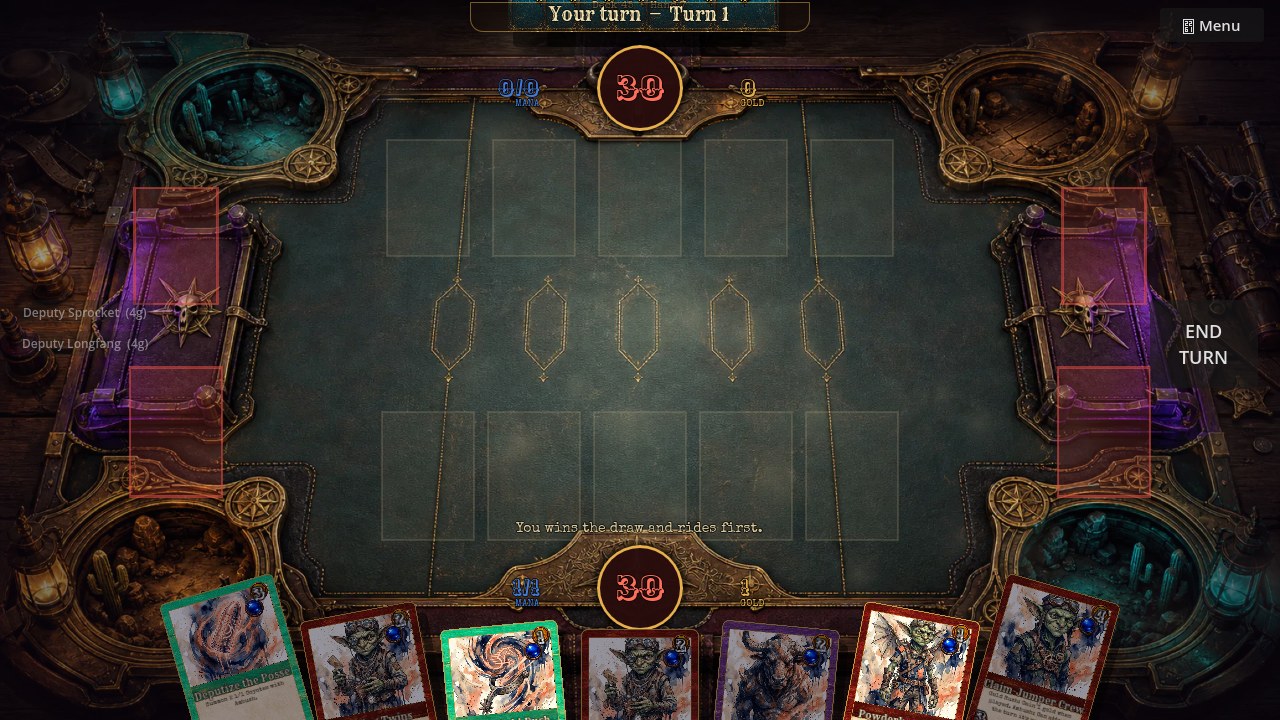
The game is free, runs in your browser with no download, and you can play the tutorial, duel the AI, build decks and open packs without an account. If you would rather have a client, it is also free on Steam in Early Access for Windows and macOS, with one account across both. There is one purchased currency — Ore — and it buys packs and cosmetics, not power; the other, Dust, is earned at the table and never sold. Every card in the game is legal, and we are not in the business of invalidating a collection you built.
We are not going to pretend that makes us saints; we would obviously like you to buy some Ore. But you should be able to read the rules of the deal before you sit down, in any game you spend your evenings on.
The Real Test
Play for two weeks without spending anything. If you are still competitive and still having fun, the game is what it says it is. If you have hit a wall that only money moves, you have your answer — and you found it before you spent anything.
That test is free to run. Run it on us in the Online Outpost, where guests can sit down without an account.